
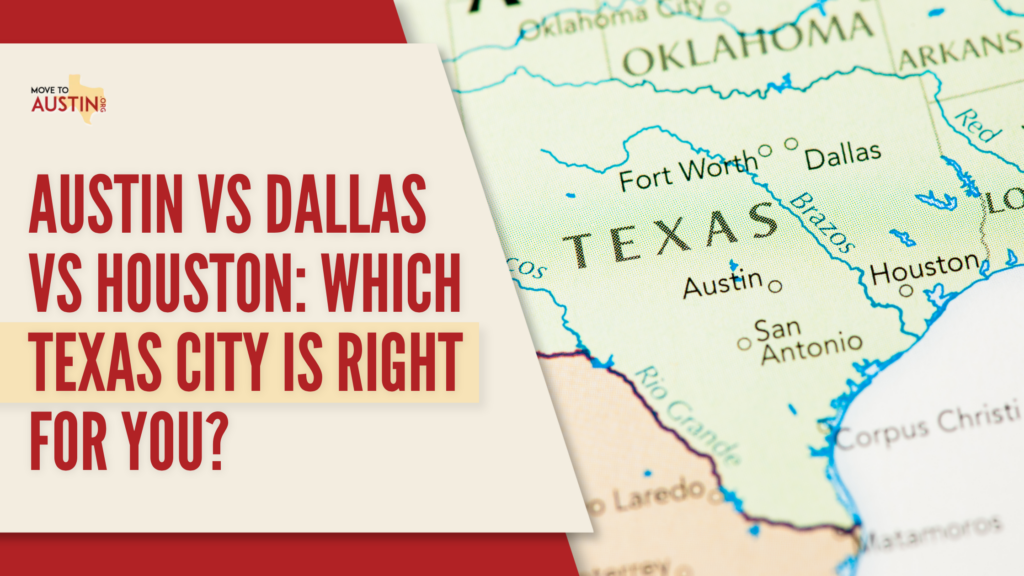
If you’re planning a Texas relocation, you’ve almost certainly found yourself comparing moving to Austin vs Dallas vs Houston at some point in your research. All three cities have compelling reasons to consider them, and none of them is obviously wrong. The challenge is that they suit very different people, priorities, and life stages.
Key Insights
- Austin leads Texas in tech and innovation employment, drawing major companies like Apple, Tesla, and Google to its growing metro workforce.
- Dallas offers the lowest overall cost of living of the three cities, with more affordable housing and a broader corporate job base spanning finance, logistics, and insurance.
- Houston is the most economically diverse metro, anchored by energy, healthcare, and one of the most internationally varied cultural scenes in the country.
- All three cities have no state income tax, but property taxes, home prices, and commute realities differ significantly between them.
- Austin consistently ranks highest for outdoor access, walkable urban neighborhoods, and quality of life for young families and remote workers.
Table of Contents
This post is a structured decision framework, not a ranking. We’re going to walk through the factors that actually drive long-term satisfaction in a city: the job market, cost of living, commute reality, neighborhoods, schools, and lifestyle. By the end, you should have a much clearer sense of which Texas city is genuinely aligned with where you’re headed.
Let’s start with the honest summary, then go deeper on each dimension. Austin skews creative, outdoorsy, and tech-driven. Dallas skews corporate, polished, and value-oriented. Houston skews global, industrial, and culturally expansive. Those aren’t stereotypes — they reflect where the jobs are, how the cities are built, and what residents actually report loving about each place.
The Job Market: Where the Opportunities Actually Live
Your industry is the single biggest filter when comparing these three metros. Each city has built a distinct economic identity, and trying to fit into the wrong one adds friction from day one.
Austin: Tech, Government, and Creative Industries
Austin has become one of the most concentrated tech employment hubs in the country. Apple’s campus in North Austin employs thousands. Tesla’s Gigafactory and headquarters are located east of the city. Google, Meta, Amazon, Oracle, and Dell all have significant Austin presences. If you work in software engineering, product, design, data science, or startup culture, Austin is the strongest match of the three cities.
State government is also a major employer, given Austin’s role as the state capital. Healthcare and the University of Texas system add significant institutional employment. For medical professionals relocating to Austin, the growth in hospital systems across the metro has been consistent and ongoing.
Dallas: Finance, Logistics, and Corporate Headquarters
Dallas-Fort Worth is the corporate relocation capital of Texas. AT&T, American Airlines, Toyota North America, and dozens of Fortune 500 companies are headquartered here. The finance and insurance sectors are particularly strong, as is logistics given the region’s central position in national supply chains.
If you work in accounting, banking, corporate management, supply chain, or healthcare administration, DFW typically offers the widest range of employers. The metro is also large enough that two-income households rarely have to compromise on one partner’s career.
Houston: Energy, Healthcare, and International Trade
Houston is the energy capital of the world, and that identity still shapes everything about its economy. If you work in oil and gas, petrochemical engineering, or energy finance, Houston is the clear answer. The Texas Medical Center, the largest in the world, also makes Houston the top destination for physicians, surgeons, researchers, and biomedical professionals.
The Port of Houston and the city’s international ties give it a unique edge in trade, import/export, and international business. Houston’s economy is broad enough to absorb downturns in any single sector more comfortably than a more concentrated city like Austin can.
Cost of Living: The Real Numbers Behind “No State Income Tax”
Every Texas city leads with the no-state-income-tax advantage, and it’s real. But it doesn’t make all three cities equivalent in cost. There are meaningful differences in housing, property taxes, and daily expenses that compound over time.
| Factor | Austin | Dallas | Houston |
|---|---|---|---|
| Median Home Price (approx.) | $530,000 | $400,000 | $310,000 |
| State Income Tax | None | None | None |
| Property Tax Rate (approx.) | 1.8–2.1% | 2.0–2.5% | 2.0–2.3% |
| Overall Cost Index vs. US avg. | ~5–8% above | ~2–4% above | Near average |
| Typical Apartment Rent (1BR) | $1,500–$1,900 | $1,400–$1,700 | $1,100–$1,500 |
Austin carries a premium, particularly in housing. That premium has moderated from the peak of 2021-2022, and the market has stabilized meaningfully, but Austin remains the most expensive of the three. The trade-off is that Austin’s housing stock has historically appreciated well over longer holds, especially in desirable central and northwest neighborhoods.
Dallas offers the most value-per-dollar of any large Texas metro for buyers in the $350,000 to $500,000 range. Houston is the most affordable entry point outright, with a larger supply of homes in the $250,000 to $350,000 range than either Austin or Dallas can offer at comparable quality levels.
For relocators coming from high-cost cities like New York, San Francisco, or Chicago, all three Texas metros will feel like a meaningful financial step forward. The distinction matters more if you’re already somewhere mid-cost and making a lateral move rather than a dramatic leap.
If you’re mapping out the full financial picture, our free Austin relocation guide walks through budgeting, neighborhood pricing tiers, and what to expect in the first 12 months after your move.
Commute and Infrastructure: The Hidden Cost of City Choice
Traffic is one of the most underestimated quality-of-life factors when relocating, because people tend to research it once and then forget about it until they’re living it every day. All three cities are car-dependent by national standards, but they have meaningfully different commute realities.
Austin’s Commute Challenge
Austin consistently ranks among the worst cities in the country for commute times relative to city size. The highway infrastructure was simply not built to handle the population it now serves. MoPac and I-35 are genuinely difficult during peak hours, and the gap between “close on a map” and “close in practice” can be significant.
The upside is that Austin’s geography is more compact than Dallas or Houston, and many tech employers offer hybrid or remote arrangements that reduce daily commute frequency. Living in the right neighborhood relative to your office makes an enormous difference here.
Dallas-Fort Worth’s Sprawl
DFW is genuinely enormous. The metro stretches across multiple counties, and where you live relative to where you work can mean the difference between a 20-minute commute and a 55-minute one. The highway system is more developed than Austin’s, and DART light rail serves parts of the city reasonably well, but it remains fundamentally a car city.
Many DFW residents end up anchoring their neighborhood choice around their specific employer’s location first, and lifestyle preferences second. This is a reasonable approach given how spread out the metro is.
Houston’s Freeway Grid
Houston has one of the most extensive freeway systems in the country, which sounds like an advantage until you’re sitting on the 610 Loop at 5:15 p.m. The city is flat and sprawling, and distances are genuinely long. That said, Houston’s grid is logical and well-connected, and off-peak travel is often faster than comparable distances in Austin.
Houston also has a light rail system (METRORail) that serves the Texas Medical Center corridor well, making it a practical option for healthcare workers specifically.
Neighborhoods and Housing Stock: What You’ll Actually Live In
Beyond price and commute, the actual character of the neighborhoods you’d be choosing from matters enormously for daily satisfaction. These three cities have very different residential textures.
Austin’s Neighborhood Landscape
Austin has a compact, walkable urban core with neighborhoods like South Congress, East Austin, Mueller, and Hyde Park that offer genuine street life, restaurants, and independent businesses within walking distance. Move outward and you find family-oriented suburbs with strong school districts, trail access, and newer construction.
The suburbs north and northwest of Austin are particularly well-regarded for families. Communities like Round Rock, Cedar Park, and Pflugerville offer larger homes at lower price points than central Austin, with good schools and access to major employers along the US-183 and I-35 corridors. If you’re exploring homes in established school zones, browsing Austin ISD homes for sale gives a useful picture of what’s available in the district boundaries that matter most to families.
Southwest Austin and the Hill Country communities of Dripping Springs and Wimberley appeal to buyers who want more acreage, natural scenery, and a slower pace without being far from the city. These areas have grown significantly as remote work has made distance from downtown more manageable.
Dallas’s Neighborhood Landscape
Dallas has some genuinely polished urban neighborhoods: Uptown, the M Streets, Bishop Arts, and Knox-Henderson all offer dense, walkable environments with strong restaurant and bar scenes. The suburb network is also extensive, with Plano, Frisco, McKinney, Allen, and Southlake each offering their own identity, school district reputation, and price point.
Dallas tends to build large. New construction in DFW suburbs often features more square footage per dollar than comparable Austin or Houston properties, which appeals strongly to families who prioritize indoor living space. The trade-off is that many suburban Dallas neighborhoods feel more car-dependent and less walkable than their Austin counterparts.
Houston’s Neighborhood Landscape
Houston’s lack of traditional zoning creates a unique, somewhat chaotic residential experience. You can find a bungalow next to a gas station next to a high-rise. This creates affordability and variety but reduces the predictability that many relocators expect. The Heights, Montrose, and Midtown are among the more walkable inner-loop neighborhoods, while Sugar Land, The Woodlands, and Katy are the major family-oriented suburbs.
The Woodlands in particular is frequently cited as one of the best-planned master communities in the country, with excellent schools, trail systems, and a genuine town center. It’s a significant commute from downtown Houston, but many residents consider it worth the trade-off.
For a more detailed look at how Austin compares to specific cities you might be leaving, our guides on moving from Chicago to Austin and moving from Miami to Austin walk through the transition in practical detail.
If you’re still in early research mode on Austin specifically, our full moving to Austin overview is a good starting point before you dive into neighborhood specifics.
Schools and Families: Comparing the Education Landscape
For families with children, school quality often becomes the dominant decision factor, sometimes overriding job proximity or housing cost entirely. All three metros have strong suburban school districts, but the access and consistency vary.
According to the Texas Education Agency, some of the top-rated districts in the state are found in the suburbs of all three metros. In the Austin area, Round Rock ISD, Lake Travis ISD, and Eanes ISD consistently earn strong performance marks. In DFW, Frisco ISD and Carroll ISD in Southlake are frequently cited among the best in the state. Near Houston, The Woodlands area (Conroe ISD) and Katy ISD also rank well.
Within Austin’s city limits, the picture is more varied. Austin ISD encompasses a wide range of schools with significant differences in resources and ratings by neighborhood. Families prioritizing school quality while staying urban will need to research specific campuses carefully rather than assuming the district as a whole performs evenly. Our post on what makes Austin great for kids covers this in depth, including parks, activities, and community resources beyond just academics.
Lifestyle and Culture: The Intangibles That Shape Daily Life
Culture and lifestyle are harder to quantify but they drive long-term satisfaction in a city more than most people expect when planning a move. The three cities really do feel different in ways that matter.
- Austin. Known for live music, outdoor recreation, independent restaurants, and a creative professional culture. Barton Springs, Zilker Park, Lady Bird Lake, and the Greenbelt provide accessible outdoor escapes. SXSW, ACL Fest, and Formula 1 anchor the city’s event calendar. Austin rewards people who value authenticity, flexibility, and outdoor access.
- Dallas. More polished and corporate in its energy. Arts District, Klyde Warren Park, and world-class museums like the Perot and the Dallas Museum of Art give the city genuine cultural weight. Shopping is exceptional, with both luxury and accessible retail well-developed. Dallas suits people who want big-city amenities, a professional social scene, and more predictable urban structure.
- Houston. The most internationally diverse of the three, with restaurant scenes that rival any city in the country for global cuisine. The Menil Collection, the Museum of Fine Arts, and Theater District give Houston serious cultural credentials that are often underestimated. Houston rewards people who value diversity, depth, and affordability over curated aesthetics.
Weather is worth noting honestly. All three cities are hot in summer, with Houston adding significant humidity and flood risk. Austin’s Hill Country setting and elevation moderate things slightly. Dallas gets genuine winter weather including occasional ice storms that can shut the city down. None of these cities are mild-climate destinations, but Austin’s seasons tend to feel the most balanced of the three to most transplants from the coasts or Midwest.
If you’re relocating from a major coastal city, moving from New York City to Austin addresses the specific lifestyle and cultural adjustments in detail, including what to expect from the transition and how to find your footing quickly.
The Decision Framework: How to Choose
Rather than declaring a winner, here’s a simple framework for using everything above to make your own call. Answer these four questions honestly, and the right city usually becomes clear.
- What industry do you work in? Tech and creative fields point to Austin. Corporate, finance, and logistics point to Dallas. Energy, medical, and international trade point to Houston.
- What’s your housing budget? Under $350,000 with room to spare points to Houston. $350,000 to $500,000 with strong value points to Dallas. Over $450,000 with an eye on appreciation points to Austin.
- What kind of neighborhood feel matters to you? Walkable, compact, and outdoorsy points to Austin. Polished, spacious, and corporate points to Dallas. Diverse, global, and eclectic points to Houston.
- Do you have children in school? All three metros have excellent suburban districts. Research specific district performance in the neighborhoods you’re already targeting by job location or budget, rather than choosing a city based on district reputation alone.
The relocation resources on this site are built specifically for people working through this kind of decision. If Austin is in your top two or three, these tools will help you go from consideration to clarity.
For corporate and employer-driven relocations specifically, our post on corporate relocation to Austin covers how to navigate the process when your employer is driving the timeline rather than your personal preferences.
Frequently Asked Questions: Austin vs Dallas vs Houston
Is Austin more expensive than Dallas and Houston?
Yes, Austin carries the highest housing costs of the three cities. The median home price in Austin runs roughly $530,000, compared to about $400,000 in Dallas and around $310,000 in Houston. Rents follow a similar pattern. However, Austin’s overall cost premium has narrowed since 2022, and the city’s long-term appreciation history is strong for buyers who plan to stay five or more years.
Which Texas city has the best job market for tech workers?
Austin is the strongest match for tech professionals, with a dense cluster of major employers including Apple, Tesla, Google, Oracle, and Meta, alongside a robust startup ecosystem. Dallas is growing in tech, particularly through corporate relocations and data center development, but Austin’s concentration of tech-specific roles remains higher. Houston’s tech sector is smaller relative to its overall economy, which is more heavily weighted toward energy and healthcare.
Do all three cities really have no state income tax?
Yes. Texas has no state income tax, which applies equally to Austin, Dallas, and Houston residents. The state makes up for this in part through property taxes, which run higher than the national average across all three metros. The effective property tax rates range from roughly 1.8% to 2.5% depending on county and city, meaning the savings from no income tax are partially offset by higher annual property tax bills than most other states.
Which city is best for families relocating to Texas?
All three metros have excellent family-oriented suburbs with strong school districts. Austin-area standouts include Round Rock ISD and Lake Travis ISD. DFW’s Frisco ISD and Southlake Carroll ISD rank among the best in the state. Near Houston, Katy ISD and Conroe ISD (serving The Woodlands area) are consistently high-performing. The best city for your family largely depends on where your employer is located and which suburban community’s lifestyle and price point align with your household’s budget.
Final Thoughts
There’s no universally right answer in the Austin vs Dallas vs Houston comparison. Each city is genuinely excellent for certain people and genuinely harder to navigate for others. The key is to run your comparison against your own life: your industry, your budget, your household’s priorities, and the kind of day-to-day environment where you tend to thrive.
Austin tends to be the strongest fit for people in tech and creative fields, those who value outdoor access and a walkable urban core, and households that can absorb a moderate housing premium in exchange for long-term appreciation and quality of life. If that profile resonates, the next step is getting specific about neighborhoods, school districts, and what the home search actually looks like from where you’re starting.
Reviewing our full moving to Austin checklist is a good next step once Austin feels like the right call. It covers everything from timeline planning to what to do in the first 30 days after you arrive.
Ready to Make Your Move to Austin?
The Relocation team knows the area’s neighborhoods inside and out. If you’re still researching or ready to tour homes, we can help you find the right fit.
Speak to a Relocation Specialist
Or start your home search and browse available listings across the Austin metro.
This post is for informational purposes only and does not constitute real estate, legal, or financial advice. Market conditions change. Please consult a licensed real estate professional before making any decisions.