
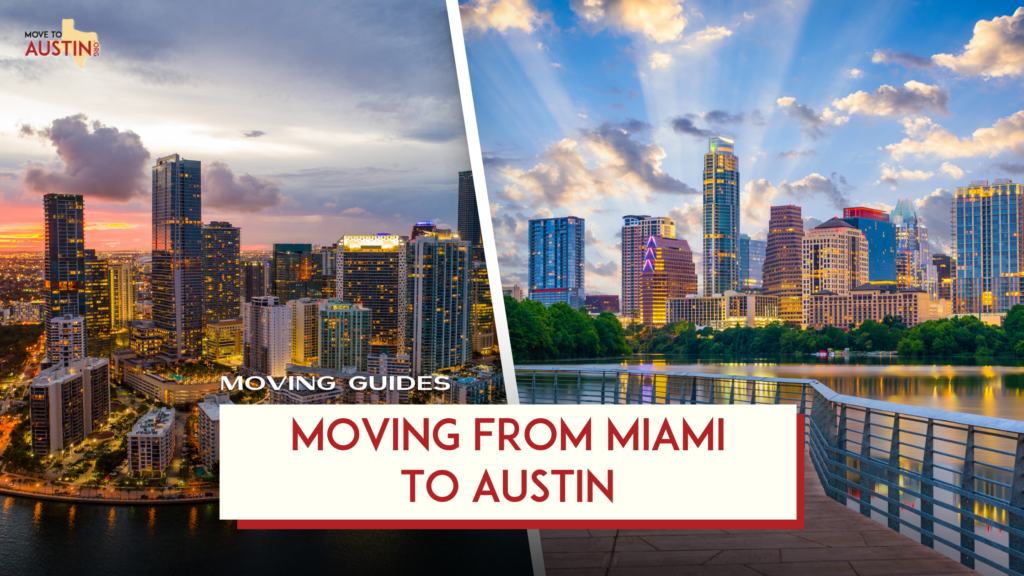
Miami and Austin share a warm climate and a no-income-tax state structure, but they are very different cities. For Miami residents considering moving to Austin, the two states diverge in ways that matter, from how property taxes work to how summers actually feel to what the housing market looks like right now.
Austin has become one of the top destinations for Miami residents relocating for career growth, lower costs, or a change of pace. The South Florida-to-Texas corridor has been one of the most active interstate migration routes in recent years, according to U.S. Census Bureau data. That movement reflects real reasons, and this guide covers them honestly.
Below is a category-by-category comparison of what changes when you leave Miami for Austin, covering cost of living, taxes, housing, jobs, climate, and lifestyle. Whether you are researching early or already have a timeline in place, this is designed to help you plan with a clear picture of what to expect.
Miami, FL to Austin, TX: Quick Snapshot
- State income tax: Neither Florida nor Texas charges state income tax; Miami residents keep their full state tax benefit
- Property taxes: Miami-Dade effective rate averages 0.89%; Austin area runs 1.6% to 2.2%
- Cost of living: Austin is more affordable than Miami across most categories, including insurance and general services
- Climate: Both are hot, but Austin summers are drier; Miami carries year-round humidity and hurricane risk
- Home prices: Austin metro median is $450,000 to $480,000; Miami median has exceeded $600,000 in recent years
- Job market: Austin’s tech and healthcare sectors are among the strongest in the country
Cost of Living: Miami vs. Austin
On a composite index basis, Texas is modestly more affordable than Florida. According to the Missouri Economic Research and Information Center (MERIC), Florida’s cost of living index runs around 100.9, while Texas sits around 93.2. That gap reflects real differences in housing costs, services, and everyday spending, though the picture is particularly relevant for Miami, which is one of Florida’s more expensive metros.
Where Austin Is More Affordable
Coming from Miami, you will likely find that Austin’s overall costs are comparable or somewhat lower, particularly for groceries, healthcare, and general services. Austin’s dining scene is expansive, and independent restaurants and markets are well distributed across the city. Goods and services are generally priced in line with or below what Florida’s coastal markets charge.
Homeowners insurance is one area where Miami residents often notice immediate relief. Florida’s insurance market has become one of the most expensive in the country due to hurricane risk and carrier exits from the state. Texas has its own weather risks, including hail and occasional flooding, but premiums for most Austin-area properties run meaningfully lower than comparable Miami coverage.
Where Miami May Have the Edge
Florida’s property tax rates are notably lower than Texas. The effective rate in Florida averages around 0.89%, compared to 1.6% to 2.2% in most Austin-area counties. For a $500,000 home, that difference can amount to $3,500 to $6,500 per year in additional property tax. This is a real cost to factor into your housing budget when comparing the two states. Austin does offer a homestead exemption that reduces your taxable value and caps annual assessment increases, but the base rate remains higher than what most Miami homeowners are used to paying.
The Tax Picture: Two No-Income-Tax States Compared
Moving from Miami to Austin does not produce the same dramatic income tax savings that Illinois or California residents experience, because Florida also has no state income tax, and Miami residents already benefit from that. But there are meaningful tax differences between the two states that are worth understanding.
Where They Diverge: Property Taxes
As noted above, property taxes are higher in Texas. The Tax Foundation ranks Texas among the top ten states for highest property tax burden. Florida ranks near the bottom, meaning this is one of the few areas where Miami residents moving to Texas will see their tax costs increase rather than decrease. Budget for this accurately when running relocation numbers.
Texas also has no estate tax, which matches Florida’s position on this issue. Both states are favorable for long-term wealth planning from an estate perspective. Sales tax in Texas runs at 6.25% at the state level, with local additions up to 2%, for a combined rate that can reach 8.25%. Florida’s combined rate is comparable, so this is not a significant shift for most households.
The Texas Homestead Exemption Explained
Once you purchase a primary residence in Texas and file for the homestead exemption, your property’s taxable value is reduced and your annual assessment increase is capped at 10% per year. This provides meaningful protection against runaway tax bills as property values rise. Florida has a similar Save Our Homes cap, so the concept will be familiar, though the Texas application process and timing differ slightly. Filing promptly after closing is recommended.
Housing in Austin for Miami Buyers
Austin’s housing market has stabilized since the peaks of 2021 and 2022. Inventory is higher, price reductions are more common, and buyers have more negotiating leverage than they did during the most competitive years. For Miami buyers who have built equity in one of the country’s most competitive housing markets, the current Austin environment presents a reasonable entry point.
What Miami Home Sale Proceeds Get You in Austin
Miami home values have risen sharply in recent years, and sellers from Miami-Dade and Broward counties often arrive in Austin with substantial equity to deploy. The Austin metro median home price in 2025 sits in the $450,000 to $480,000 range, according to Austin Board of Realtors data. Buyers coming from Miami frequently find that their sale proceeds cover a meaningful down payment or allow for an all-cash purchase in Austin’s more affordable suburban areas.
Best Austin Neighborhoods for Miami Transplants
Miami transplants tend to gravitate toward areas with walkable amenities, a vibrant dining scene, and access to outdoor recreation. The neighborhoods in Austin vary considerably in character, and matching your lifestyle to the right area makes a significant difference in how quickly you settle in.
- South Austin. Relaxed, walkable, and community-oriented. Close to Barton Springs and the Greenbelt. Popular with buyers who want character and outdoor access.
- East Austin. Vibrant, urban, and dense with dining and nightlife. A natural fit for those coming from Wynwood, Brickell, or the Design District.
- Lakeway and Bee Cave. Waterfront and Hill Country access near Lake Travis. Appeals to Miami buyers accustomed to waterfront living who want to stay near the water.
- Round Rock and Cedar Park. Family-oriented suburbs with newer construction, strong schools, and HOA communities similar to Miami’s master-planned suburban developments.
- West Lake Hills. Established luxury area with Hill Country views, top-rated schools, and a quieter residential character.
Renting First vs. Buying Immediately
Many Miami buyers choose to rent for 6 to 12 months after arriving before committing to a purchase. Austin’s geography and traffic patterns are not always intuitive on a map, and spending time in different parts of the city helps you understand where you actually want to be. For those ready to buy on arrival, working with an Austin-focused buyer’s agent, such as the team at Spyglass Realty, can help you move efficiently without sacrificing due diligence. You can also explore the full process through the buying a home in Austin guide on this site.
Free Resource
The Free Austin Relocation Guide
Everything you need to plan your move, from neighborhoods and schools to cost of living and what to expect when you arrive. Download it free and keep it as your reference throughout the process.
Jobs and Career Opportunities in Austin
Austin’s job market has diversified steadily over the past decade. What was once a government and university-driven economy now includes major tech campuses, healthcare systems, financial services firms, and a growing manufacturing base. For Miami professionals across a range of industries, Austin offers a competitive and growing employment landscape.
Austin’s Key Industries vs. Miami’s
Miami’s economy is heavily weighted toward finance, international trade, real estate, tourism, and healthcare. Austin’s economy is anchored by technology, semiconductor manufacturing, higher education, healthcare, and increasingly finance. Major employers in the Austin metro include Dell, Apple, Tesla, Oracle, Amazon, Samsung, and Ascension Seton. For professionals in tech, engineering, finance, or healthcare looking to work in a faster-moving corporate environment, Austin’s tech sector in particular is a strong draw for Miami professionals in engineering, software, and fintech looking for a different market with lower costs.
According to the Bureau of Labor Statistics, Austin’s unemployment rate has held in the low-to-mid 3% range, indicating sustained demand for skilled workers. You can explore what the Austin employment landscape looks like across key sectors through the work in Austin resources on this site.
Remote Workers and the Austin Advantage
A significant portion of Miami-to-Austin movers are remote workers who retain their current employer while relocating. For this group, the financial case is straightforward: Austin’s overall costs are lower than Miami across most categories, the quality of life is strong, and there is no state income tax in either location, so the transition does not introduce new tax complexity. The primary adjustment is car dependency, since Austin requires a vehicle for most daily tasks in a way that Miami’s walkable neighborhoods do not.
Climate: Swapping Miami Heat for Texas Heat
Both Miami and Austin are hot. But the nature of the heat is different, and that difference matters for daily comfort and lifestyle planning.
Season by Season in Austin
According to NOAA climate data, Austin averages 228 sunny days per year, compared to Miami’s average of roughly 248 sunny days per year. Winters in Austin are mild, with temperatures generally between 40 and 65 degrees Fahrenheit, and hard freezes are occasional rather than routine. Spring is widely considered Austin’s best season, with blooming wildflowers and pleasant outdoor temperatures from March through May. Summer runs hot from June through early September, with temperatures regularly reaching 95 to 105 degrees Fahrenheit.
How Austin and Miami Summers Actually Differ
Miami’s summer heat is defined by humidity, with dewpoints that make 90 degrees feel significantly more oppressive than the temperature suggests. Austin’s summer heat is drier, which many Miami residents find more manageable even at higher temperatures. Afternoon thunderstorms are common in both locations during summer. The notable difference is hurricane risk: Austin does not carry meaningful hurricane exposure, whereas Miami and South Florida communities face real seasonal hurricane risk and the associated insurance and preparation costs that come with it.
Lifestyle: What Changes and What Stays the Same
Austin and Miami share an outdoor-oriented culture and a love of food, music, and warm weather that makes the transition feel more natural than moves from colder or more formal cities. There are real differences in what each place offers, but Miami transplants often report settling into Austin relatively quickly.
Outdoor Life, Food, and Culture in Austin
Austin’s outdoor offerings are different from Miami’s but genuinely substantial. Barton Springs Pool, the Barton Creek Greenbelt, Lady Bird Lake, and the Texas Hill Country provide year-round recreation options. Water access is available at Lake Travis and Lake Austin for boating and swimming, which resonates with Miami residents accustomed to water-based leisure. The live music culture, independent restaurant scene, and community events calendar give Austin a lively social fabric. If you want to get a sense of what day-to-day life looks like, the things to do in Austin page covers the landscape well.
What Miami Transplants Often Say After Year One
Miami transplants almost universally cite the absence of ocean access as the biggest lifestyle adjustment. Austin is landlocked, and while its lakes and rivers are genuinely enjoyable, they are not a substitute for beach access. Some people handle this easily; others make a point of traveling to the Texas Gulf Coast a few times a year to fill that gap. The city’s strong food culture, active event scene, and mild winters tend to offset the adjustment for most new residents over time. For help matching your priorities to the right part of the metro, the Austin relocation resources on this site are a practical starting point.
Frequently Asked Questions
Is Austin cheaper than Miami to live in?
On a composite index basis, Texas runs modestly more affordable than Florida overall, and Austin compares favorably to Miami specifically. Texas scores around 93.2 on the MERIC index versus Florida’s 100.9. The biggest cost advantage in Texas is homeowners insurance, which tends to be significantly lower than Florida’s elevated rates. The area where Florida is cheaper is property taxes, as Florida’s effective rate is well below what most Austin-area homeowners pay. For Miami households specifically, Austin tends to be meaningfully more affordable, and often somewhat less expensive once insurance and services are factored in.
What is the property tax difference between Miami and Austin?
Florida’s effective property tax rate averages around 0.89%, while Texas effective rates in the Austin area typically run between 1.6% and 2.2%. On a $500,000 home, that can mean paying $3,500 to $6,500 more per year in Texas than you would on a comparable property in Florida. Filing for the Texas homestead exemption after purchase reduces your taxable value and caps annual assessment increases at 10%, providing some relief over time.
What neighborhoods in Austin are popular with Miami transplants?
Miami transplants often gravitate toward South Austin for its walkability and outdoor access, Lakeway and Bee Cave for lake proximity, and Round Rock or Cedar Park for family-oriented communities with master-planned amenities. Buyers from Brickell or the urban core of Miami tend to find East Austin a natural fit for its density and dining culture. Spending time in multiple neighborhoods before committing to a purchase is the most reliable way to find the right match.
Is it worth moving from Miami to Austin?
For Miami households, Austin offers a comparable or lower overall cost of living, a strong job market, and significantly lower homeowners insurance costs. The trade-offs are higher property taxes and no ocean access. Whether the move makes sense depends on your specific financial profile, career situation, and lifestyle priorities. For most working households relocating for career reasons or seeking a lower insurance environment, Austin compares favorably.
Ready to Make Your Move?
Talk to a Move to Austin Relocation Specialist
Whether you are still comparing your options or ready to start your Austin home search, our relocation specialists can help you build a focused plan around your timeline, budget, and priorities.
Disclaimer: This article is for general educational purposes only and is not legal, tax, or financial advice. Every situation is different. Before making decisions about buying or selling a home, consult with your own real estate professional, lender, tax advisor, and other qualified professionals.