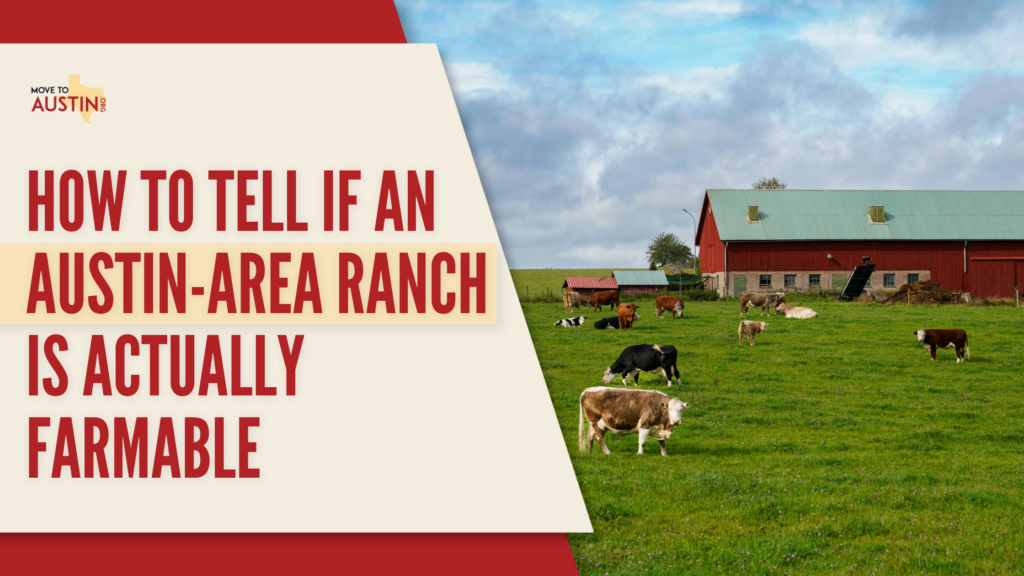
The listing says “working ranch.” The photos show a stock tank, a few cedar-post fences, and a backdrop of Hill Country limestone. It looks the part. But evaluating farmable ranch land in Austin, Texas takes more than a scenic drive and a marketing brochure — and buyers who skip the due diligence step often discover the gap between perception and reality after closing.
Key Insights
- Many rural parcels near Austin are marketed with agricultural language but have soil, topography, or water limitations that prevent practical farming or grazing.
- Texas has over 248,800 farms and ranches, but proximity to Austin has shifted many rural parcels toward lifestyle and investment use rather than active production.
- USDA Web Soil Survey and the Texas A&M AgriLife Extension Service are two of the most reliable free tools for independently verifying soil quality before you buy.
- Agricultural tax exemptions (ag exemptions) in Texas have specific production requirements — a property can hold an exemption without currently meeting those requirements.
- Water access, including well depth, tank reliability, and surface water rights, is often the single biggest limiting factor on a parcel’s true farmable potential.
- Engaging a licensed land specialist and an independent appraiser experienced with Texas ranch properties is the most reliable way to ground-truth a listing’s agricultural claims.
Rural parcels in the Austin metro and surrounding counties are selling at a premium, partly because demand for land with agricultural character has grown significantly as the city itself has expanded. That demand has also created an incentive for sellers to frame lifestyle acreage in production-farming language, even when the land’s actual agricultural utility is limited.
This guide gives you a practical framework for reading past the marketing and asking the right questions before you commit. Whether you’re planning a small hobby farm, genuine grazing operation, or a mixed-use rural homestead, the evaluation process follows the same core steps.
Table of Contents
Why “Agricultural” Marketing Doesn’t Always Mean Agricultural Capability
Texas leads the nation in farms and ranches, with more than 248,800 operations covering roughly 130 million acres. But not all of that land is equally productive, and not all of it near Austin is marketed honestly relative to its actual output.
The pressure on land prices in Travis, Williamson, Hays, Bastrop, and Caldwell counties has pushed values well above what agricultural income alone could justify. That means sellers have a financial incentive to emphasize agricultural features, and buyers have a real need to evaluate those claims independently.
A parcel can carry an agricultural tax exemption, have a stock tank on the property, and be grazed by a handful of goats, and still not be meaningfully farmable at any productive scale. Each of those signals tells you something, but none of them alone confirms true agricultural utility.
The Ag Exemption Is Not a Farming Certification
One of the most common misreads buyers make is treating an active agricultural tax exemption as proof that a property is productively farmed. In Texas, ag exemptions are valuable — they can dramatically reduce a property’s tax burden — but they require only that the land be used with the intent of producing agricultural products for sale.
That standard is broad. A few beehives, a small hay lease, or minimal goat grazing can qualify under certain county appraisal interpretations. The exemption tells you how the land has been classified for tax purposes. It does not tell you whether the soil can sustain row crops, whether the pasture can carry cattle at a viable stocking rate, or whether the property has reliable water for irrigation.
Always ask for the current agricultural lease or production documentation, not just confirmation that an exemption exists. If the seller can’t produce either, that’s a meaningful signal worth investigating further.
Evaluating Farmable Ranch Land: The Four Core Factors
Productive agricultural land comes down to four variables: soil quality, water access, topography, and land cover. A parcel that scores reasonably well across all four is genuinely farmable. A parcel that is strong in one but weak in the others usually has a ceiling on what it can realistically produce.
Soil Quality: Start with the USDA Web Soil Survey
The USDA’s Web Soil Survey (WSS) is a free, publicly accessible tool that maps soil types down to the parcel level across most of Texas. Before you schedule a second showing on any rural property, pull up the WSS map for that tract and look at the land capability classification.
Class I and Class II soils are the most versatile and productive — suitable for a wide range of crops with few limitations. Class III soils have moderate limitations and may require special conservation practices. Class IV and above have significant restrictions: shallow depth, high clay content, excessive stoniness, or slope issues that limit agricultural options considerably.
Much of the Edwards Plateau and eastern Hill Country around Austin sits on thin, rocky soils over limestone — scenic, but often Class VI or VII, which are generally unsuitable for cultivation and limited even for grazing. Buyers drawn to the visual character of that landscape should go in with realistic expectations about what it can produce.
The Texas A&M AgriLife Extension Service offers county-level soil and crop suitability information as well, and their local offices can often provide a faster read on what specific soil types in a given county can realistically support.
Water Access: The Most Frequently Underestimated Variable
Water is often the deciding factor on whether a rural parcel can sustain any real agricultural use. In Central Texas, surface water is unreliable across much of the region, and groundwater access varies significantly by county and by the specific aquifer underlying the property.
Stock tanks — the ponds that appear in almost every ranch listing photo — are weather-dependent. During drought conditions, which are recurring across Central Texas, tanks can go dry for months. A tank that looks full in March may be a cracked mud bed in September.
Ask these specific questions about any rural property you’re evaluating seriously:
- Is there a water well on the property? How deep is it, and what is its tested yield in gallons per minute?
- Which groundwater conservation district has jurisdiction, and what are the pumping rules?
- Does the property have any surface water rights, or are those severed from the deed?
- Has the stock tank held water through recent drought years?
- Is there an existing irrigation system, and what is its permitted capacity?
A property with a shallow, low-yield well and one seasonal tank is not set up for irrigated row crops or for running cattle through a dry summer. That doesn’t make it a bad property, but it’s essential information that shapes what you can realistically do with the land.
Topography: Slope, Drainage, and Usable Acreage
The total acreage on a deed does not equal the usable agricultural acreage. Steep terrain, rock outcroppings, cedar breaks, and flood-prone creek bottoms can reduce a property’s workable footprint substantially.
A 50-acre tract that looks open from the road may have 20 acres of usable pasture and 30 acres of heavily wooded, rocky slope that can’t be grazed or cultivated. Ask the seller or listing agent for a breakdown of terrain by type, then verify it using satellite imagery and topographic maps before you rely on that number.
The USDA Web Soil Survey also includes slope percentage data by soil unit, which can help you cross-reference how much of a parcel is realistically cultivable versus what’s constrained by grade. Anything over a 15-percent slope is generally not suitable for cultivation equipment, and slopes above 8 percent require careful management even for grazing.
Check for Flood Zone Status
Creek-adjacent acreage is attractive and often priced as premium land, but significant floodplain designation can limit what’s permissible or financially viable to build and use. Review the FEMA Flood Map Service Center data for any parcel that includes a drainage or creek feature. Productive bottomland can be among the most fertile ground on a property, but only if it’s workable rather than regularly inundated.
Land Cover: What’s Actually Growing There Now
Existing land cover tells you a great deal about a property’s history and its near-term agricultural potential. Healthy, diverse native pasture grass is a positive indicator. Dense cedar (Ashe juniper) monoculture typically signals long-term overgrazing or neglect — and cedar clearing is both expensive and labor-intensive before that land becomes pasture again.
Walk the property at different points, not just the areas near the entrance. Look for signs of erosion, bare soil in pasture areas, invasive species like KR bluestem, and the condition of any existing fencing. These are all indicators of how the land has been managed — and how much remediation work it may need before it produces anything.
If the seller describes a property as “lightly grazed,” ask for stocking records. If they can’t provide them, hire an independent range consultant to assess carrying capacity before you finalize your offer.
Understanding the Difference Between Farm Land and Ranch Land Near Austin
The Austin metro’s rural fringe spans multiple counties with meaningfully different soil profiles and land use histories. Knowing what type of land each corridor is best suited for helps you match a property to your actual goals. Our overview of the best farm and ranch areas near Austin breaks down the regional differences worth understanding before you start shopping by ZIP code.
Here’s a general orientation to how the primary rural corridors around Austin differ in agricultural character:
| Corridor / County | Typical Soil Character | Best Agricultural Use | Common Limitations |
|---|---|---|---|
| Bastrop County (east) | Sandy loam, deeper profiles | Row crops, hay, small vegetables | Irrigation dependency in dry years |
| Caldwell County (south) | Black clay (Blackland Prairie) | Row crops, grazing | Shrink-swell clay limits some uses |
| Hays County (west/SW) | Thin, rocky over limestone | Limited grazing, wildlife, recreation | Poor cultivation potential |
| Williamson County (north) | Mixed — Blackland and sandy | Hay production, diversified grazing | Fragmented parcels near development |
| Travis County (west) | Edwards Plateau, rocky | Wildlife, limited grazing | Very thin topsoil, drought-prone |
This is a general guide, not a universal rule — within each county, soil types can shift significantly across a few miles, and individual parcels vary. Always verify at the parcel level using WSS data.
Residential Ranch Communities vs. Working Ranch Land
It’s worth drawing a clear line between planned residential communities with “ranch” in the name and actual rural acreage with genuine agricultural utility. Several of Austin’s most established master-planned communities use ranch terminology in their branding, and they’re excellent places to live — but they are residential neighborhoods, not working farms.
Communities like Steiner Ranch in northwest Austin and Santa Rita Ranch in Georgetown are well-regarded residential developments with strong schools, amenities, and community infrastructure. They offer a connected, suburban lifestyle in a scenic setting. What they are not — and don’t claim to be — is farmable acreage.
Similarly, Arrowhead Ranch near Dripping Springs and Butler Ranch in the same corridor offer a Hill Country aesthetic with residential amenities. These are strong options for buyers who want the feel of ranch country without the operational complexity of actual land management.
If your goal is genuine agricultural use, you’ll be looking at rural parcels outside these planned developments, typically on larger tracts of unplatted acreage. The evaluation framework in this guide applies to those unplatted rural properties. If your goal is a scenic home base in a ranch-branded community, those residential neighborhoods are worth evaluating on their own merits.
Who to Hire Before You Make an Offer
Evaluating rural land for agricultural utility is a specialized process, and the standard residential home inspection is not designed for it. Build a professional team that includes people who actually know land.
- Licensed land specialist or ranch broker. Look for agents who hold the Accredited Land Consultant (ALC) designation or who specialize specifically in Texas farm and ranch transactions. They know how to read a soil survey, ask about water rights, and evaluate carrying capacity in ways a residential agent typically doesn’t.
- Independent land appraiser. If the seller’s listing price is based in part on agricultural value or ag-exempt tax treatment, an independent appraiser with rural land experience can tell you whether that valuation holds up.
- Range or soil consultant. For larger parcels or any property where you plan active agricultural production, a Texas-licensed range consultant can assess carrying capacity, pasture condition, and remediation costs accurately.
- Water well inspector. Have any existing well tested for yield, pressure, and water quality before closing. Replacing or deepening a well is expensive, and discovering low yield post-closing is a costly surprise.
- Real estate attorney familiar with Texas land law. Surface rights, mineral rights, water rights, easements, and deed restrictions on rural property can be complex. Legal review of the title and deed is not optional.
The Texas Farm and Ranch contract used in land transactions has specific provisions around water, minerals, and agricultural use that differ from the standard residential purchase agreement. Knowing those differences before you sign matters considerably.
Frequently Asked Questions About Evaluating Farmable Ranch Land Near Austin
What does an agricultural tax exemption actually tell a buyer?
An ag exemption tells you that a property is currently classified for agricultural use by the county appraisal district, which significantly reduces the property tax burden. It does not confirm that the land is productive, well-managed, or suited to the type of farming or ranching you’re planning. The exemption can be maintained with minimal production activity — such as a hay lease or a small number of livestock — that doesn’t reflect the land’s actual carrying capacity. Always request documentation of the agricultural activity supporting the exemption, not just confirmation that one exists. If you fail to continue qualifying agricultural use after purchase, rollback taxes for up to five years can be assessed.
How do I check soil quality on a rural property before making an offer?
The best starting point is the USDA Web Soil Survey at websoilsurvey.usda.gov, which is free and maps soil types at the parcel level across Texas. Look at the land capability classification for the specific tract. You can also contact the Texas A&M AgriLife Extension office in the relevant county for guidance on what soil types in that area are suited to. For parcels where you plan significant investment, hire a licensed soil or range consultant to walk the property and provide a written assessment before you finalize any offer.
Is Hill Country land near Austin actually farmable?
Much of the Hill Country terrain in Hays, western Travis, and Blanco counties has thin, rocky soils over Edwards Plateau limestone — generally Class VI or VII land capability, which is not suitable for cultivation and has limited grazing value. These properties can be beautiful, and they support wildlife, recreation, and low-density residential use well. But buyers who plan active row crop farming or high-density livestock grazing on this type of land typically face steep challenges. The eastern and northern corridors around Austin, including parts of Bastrop and Williamson counties, tend to have more agriculturally productive soil profiles.
What water rights questions should I ask before buying rural land near Austin?
Start by asking whether the property has a water well and what its tested yield in gallons per minute is. Determine which groundwater conservation district has jurisdiction and whether there are any pumping restrictions. Ask about surface water rights and confirm they are included in the deed, not severed. Assess the reliability of any stock tanks by asking how they’ve performed during recent drought years. For any land where you plan irrigation, confirm whether a permitted water right exists for surface water use. Water access is frequently the binding constraint on what a rural parcel can realistically produce, and it’s the question most buyers leave for too late in the process.
A Realistic Approach Produces Better Outcomes
Buying rural land near Austin can be a sound long-term decision — the region has genuine agricultural history, a diverse range of soil and water conditions, and a buyer’s market for patience and preparedness. The buyers who get the most out of these purchases are the ones who go in with clear goals, realistic expectations about what the land can produce, and a team of professionals qualified to verify the claims in a listing.
The goal isn’t to talk you out of a ranch purchase — it’s to help you buy the right one. A property that is genuinely suited to your agricultural intentions is worth every dollar. A property that’s been marketed beyond its actual capability is a financial and operational problem that compounds over time.
If you’re still orienting to the broader Austin area and want to understand the metro before narrowing to rural land, our free Austin relocation guide is a good place to build that foundation. And if you’re ready to talk through your specific land goals, our team is here to help you think through it clearly.
Ready to Make Your Move to Austin?
Our relocation team knows the Austin metro’s rural corridors, community character, and land market well. If you’re evaluating ranch or farm properties and want a grounded second opinion, we’re glad to help you think it through.
Speak to a Relocation Specialist
Or start your home search and browse available listings across the Austin metro, including rural and acreage properties.
This post is for informational purposes only and does not constitute real estate, legal, or financial advice. Market conditions change. Please consult a licensed real estate professional before making any decisions.