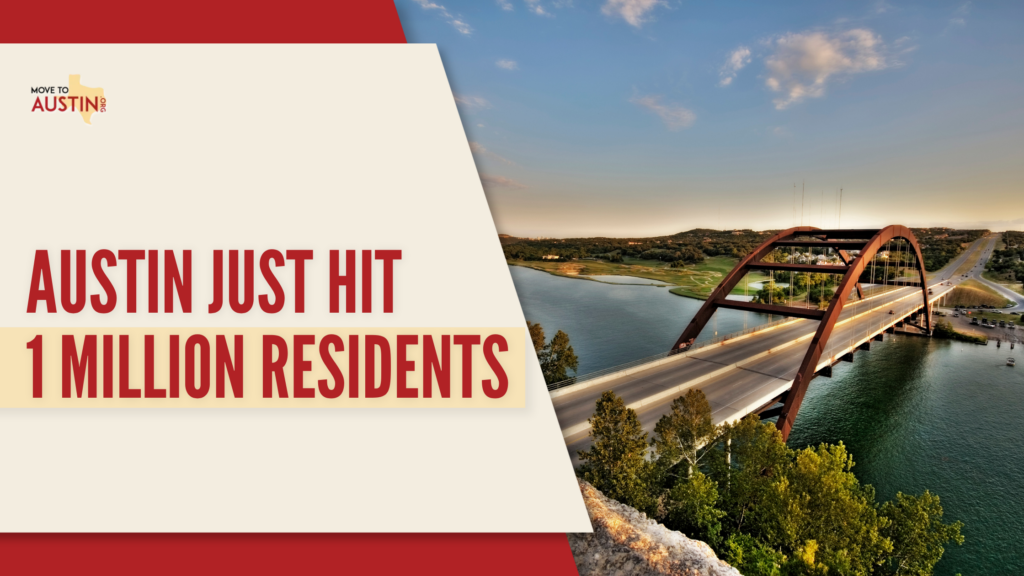
Austin has been edging toward 1 million residents for years. In May 2026, it finally crossed the line. According to Austin Current, the city officially surpassed that population threshold, making Austin one of the fastest large cities in the country to reach this mark in the modern era.
Key Insights
- Austin officially crossed 1 million residents in 2026, a milestone that signals a structural shift in how the city grows, not just how fast.
- Reaching this threshold accelerates infrastructure investment and transit planning, but also intensifies competition for housing in core neighborhoods.
- Relocators targeting popular inner-ring areas will find tighter inventory and higher price floors than even three years ago.
- Suburban communities north, northwest, and southwest of Austin continue to absorb much of the population growth with newer housing stock and more land.
- Understanding what “1 million residents” actually changes, versus what stays the same, gives relocators a more realistic foundation for their search.
For people already living here, it confirms what they’ve felt in traffic, at restaurants, and in their property tax bills. For relocators still deciding on a destination, it raises a fair question: does this milestone change the math on moving to Austin?
The honest answer is: it changes some things, and leaves others more stable than headlines suggest. This post breaks down what the 1-million-resident threshold actually shifts in terms of housing supply, neighborhood character, and infrastructure — and what it means for the specific communities most relocators are researching right now.
Table of Contents
What Crossing 1 Million Actually Signals (Beyond the Number)
Population milestones get attention because they’re clean and countable. But the meaningful story isn’t the number itself — it’s what happens structurally when a city crosses from large to major.
Cities at the 1-million mark attract a different class of federal infrastructure funding, tend to qualify for expanded transit grants, and draw Fortune 500 site-selection attention in ways that mid-sized metros don’t. Austin has already been benefiting from some of that momentum, but formal population confirmation accelerates it.
It also signals density pressure. When a city’s population grows incrementally, neighborhoods absorb newcomers gradually. When a city surpasses a threshold this visible, the pace of in-migration often intensifies as the city’s profile rises further. That creates real effects on housing supply, pricing, and neighborhood feel — especially in areas that haven’t expanded their housing stock proportionally.
Growth Is Not Evenly Distributed
One of the most important things relocators should understand about Austin reaching 1 million is that the growth isn’t uniform across the city. Inner-core neighborhoods close to downtown have added residents slowly, constrained by lot sizes, zoning limits, and existing development. The suburbs outside Austin’s city limits have added residents much faster.
This matters for where you choose to live. The neighborhoods with the most cultural identity and walkability often have the least room to grow. The areas with the most new construction are further out. Neither is inherently better — they just serve different lifestyle priorities.
How Austin’s Housing Market Absorbs a Million-Person City
Austin’s housing market has been recalibrating since the sharp price run-up of 2021 and 2022. Inventory has increased across most submarkets, and price growth has moderated from its peak pace. But crossing 1 million residents changes the demand floor in ways that matter for relocators planning a purchase.
A larger population base means a larger pool of buyers and renters competing for available units. Even when interest rates are elevated and demand softens seasonally, 1 million residents creates structural demand that keeps the market more resilient than comparably sized metros with flat or declining population.
For relocators, the practical implication is that Austin is unlikely to see the kind of prolonged price softening that might characterize a city losing population. The floor is higher here. That’s not a guarantee of appreciation — it’s a reflection of sustained demand pressure that supports long-term stability.
Where Inventory Is Loosening vs. Where It Remains Tight
Not all submarkets are behaving the same way. Inner-loop neighborhoods, particularly those within two to three miles of downtown, still carry premium prices and relatively tight inventory. Entry-level and mid-range supply is most constrained in these areas.
Further out, in the suburban ring extending 15 to 30 miles from downtown, new construction pipelines have added meaningful inventory. Builders have remained active in communities like South Austin and the broader metro, giving relocators more options at more accessible price points.
For anyone buying a home in Austin in this environment, understanding which submarket aligns with your budget and lifestyle prevents a lot of frustration early in the search process.
Austin 1 Million Residents: What It Means for Infrastructure and Commutes
One of the most tangible effects of reaching 1 million residents is the pressure it puts on roads, transit, utilities, and public services. Austin has been building toward this capacity for years, but the city’s infrastructure has historically lagged behind its population growth.
The good news is that crossing this threshold tends to unlock a different level of federal and state attention. Major transit investments, highway expansions, and water infrastructure projects get prioritized differently for million-plus cities. Austin’s Project Connect light rail initiative, while still evolving, reflects that shift in ambition.
The realistic expectation for relocators is that commute times and traffic in the core will remain a challenge for several more years as infrastructure catches up. This is a reason why many relocators prioritize proximity to their employer — or choose neighborhoods with meaningful transit access — over maximizing square footage or lot size.
The Commute Trade-Off Is Real and Worth Planning Around
Austin’s road network was not designed for a million-person city. The I-35 corridor remains one of the most congested stretches in Texas, and MoPac is not far behind during peak hours. Relocators who choose to live 25 to 30 miles out to access lower home prices will pay for that decision in daily drive time.
A useful framework: every five miles further from your employer translates to roughly 10 to 15 additional minutes of commute time in Austin’s traffic conditions. That compounds across a work week quickly. For some households, that trade-off is worth the price savings. For others, it erodes quality of life faster than expected.
Being intentional about where you live relative to where you work — and where your kids go to school — is one of the highest-value decisions you’ll make in the relocation process. Austin’s size now makes that calculus more consequential than it was five years ago.
The Neighborhoods Relocators Are Targeting Most in 2026
Austin’s growth hasn’t dimmed interest in its most distinctive neighborhoods — but it has changed what’s realistic at different budget levels. Here’s an honest look at what relocators are finding in the areas they’re researching most.
For a broader orientation to Austin’s geographic layout and neighborhood character, the neighborhoods in Austin overview is a useful starting point before diving into specific communities.
Inner East Austin and the Core
East Austin, Hyde Park, and the areas within Loop 360 and Highway 183 remain among the most sought-after for relocators who want walkability, cultural access, and proximity to downtown employers. These neighborhoods have strong character, established dining and nightlife scenes, and relatively short commutes into the urban core.
The trade-off is price. Median home prices in established inner-core neighborhoods regularly run between $550,000 and $750,000 or higher depending on the block. Inventory in these areas tends to move faster than the broader metro average, and buyer competition remains meaningful for well-priced properties.
Relocators drawn to Austin’s most distinctive neighborhoods often find that their budget determines whether they buy in the core or rent there while purchasing further out. Both strategies have merit depending on your financial position and timeline.
South Austin
South Austin has long attracted residents who want Austin’s creative energy without the full price premium of neighborhoods immediately north or east of the river. The area stretches south of Lady Bird Lake into communities like South Congress, Bouldin Creek, and Slaughter Lane further out.
Prices in South Austin vary considerably by proximity to downtown. Properties within two miles of the river often price similarly to inner East Austin. Move further south toward William Cannon or Slaughter Lane, and mid-range options in the $425,000 to $550,000 range become more accessible, though inventory fluctuates seasonally.
South Austin also offers access to Austin ISD schools, which remain a significant draw for relocating families. Homes within desirable Austin ISD boundaries tend to carry a premium, so exploring Austin ISD homes for sale with that filter in mind early in your search saves time.
The Northern Suburbs: Round Rock, Pflugerville, and Hutto
North of Austin, communities like Round Rock, Pflugerville, and Hutto have absorbed enormous amounts of the metro’s growth over the past decade. They offer newer housing stock, larger lot sizes, and generally lower price per square foot than inner Austin — along with their own school districts and local amenities that have matured significantly.
Round Rock in particular sits in a strong position for relocators. Median home prices generally range from $380,000 to $480,000 depending on subdivision and vintage, offering meaningfully more space for the dollar than comparable properties inside Austin city limits. Round Rock ISD is consistently well-regarded, and the community’s proximity to major employers along the North Austin tech corridor makes it practical for commuters.
Pflugerville and Hutto offer similar value propositions at slightly lower entry points in many cases, with active new construction pipelines giving relocators the option to buy from a builder with a warranty rather than navigating the resale market. For tech workers especially, the best neighborhoods for tech workers in Austin guide covers this corridor in useful detail.
The Western and Southwestern Growth Corridor
Bee Cave, Lakeway, and Dripping Springs to the west and southwest have attracted relocators who prioritize Hill Country access, newer development, and top-rated schools. These communities sit further from downtown Austin — typically 25 to 40 minutes depending on the time of day — but offer a noticeably different lifestyle.
The Lake Travis ISD area is one of the most consistently requested school districts from relocating families with school-age children. Homes in the Lakeway and Bee Cave area tend to range from $500,000 to $800,000 for a typical family home, with luxury properties extending considerably higher along the lakefront.
Dripping Springs offers a slightly more rural character at a somewhat more accessible price point in many of its newer subdivisions. It’s also producing some of the more interesting new and upcoming neighborhoods in the metro as builders continue to break ground on large master-planned communities.
| Area | Typical Price Range | School District | Distance to Downtown | Best For |
|---|---|---|---|---|
| Inner East / Core | $550K – $750K+ | Austin ISD | 2-5 miles | Walkability, urban lifestyle |
| South Austin | $425K – $600K | Austin ISD | 3-10 miles | Creative culture, value |
| Round Rock | $380K – $480K | Round Rock ISD | 20-25 miles | Families, tech commuters |
| Pflugerville / Hutto | $330K – $430K | Pflugerville / Hutto ISD | 20-30 miles | New construction, value |
| Lakeway / Bee Cave | $500K – $800K | Lake Travis ISD | 25-35 miles | Hill Country, top schools |
| Dripping Springs | $420K – $580K | Dripping Springs ISD | 30-40 miles | Suburban-rural blend |
What Neighborhood Character Looks Like in a Million-Person Austin
One of the more personal concerns relocators raise is whether Austin still feels like Austin. Growth at this scale does change things — that’s an honest answer. But it changes different neighborhoods in different ways, and the picture is more nuanced than “it’s been ruined” or “it’s better than ever.”
Established inner-ring neighborhoods have generally held their character while becoming more expensive. The small businesses, local restaurants, and community institutions that define neighborhoods like Barton Hills, Cherrywood, or Crestview haven’t disappeared — they’ve been joined by more of everything, which pleases some residents and frustrates others.
Newer outer suburbs have a different kind of character: master-planned and intentional, with amenity packages, trail systems, and community pools built in from the start. They trade spontaneity for reliability. For families with young children, that trade-off is often a positive one. For single relocators or couples who want a more organic neighborhood feel, it may not be the right fit.
Finding the Right Fit for Your Lifestyle
Austin at 1 million is genuinely a city that can accommodate a wide range of lifestyle preferences. That breadth is one of its most underappreciated strengths. The challenge for relocators is narrowing from “Austin” to the specific community that aligns with how you actually want to live day to day.
Thinking through questions like proximity to work, school district priorities, housing type preferences, and weekend lifestyle before you start visiting neighborhoods will make your search dramatically more efficient. The free Austin relocation guide is a practical starting point for structuring that thinking before you tour.
Medical and healthcare professionals relocating to Austin may also find the northern tech and medical corridor particularly relevant given the concentration of hospital systems and research institutions there. The medical professional relocation guide for Austin covers employer-specific considerations that aren’t part of a general neighborhood search.
Frequently Asked Questions About Austin’s Population Milestone
When did Austin officially reach 1 million residents?
Austin crossed the 1 million resident threshold in 2026, with the milestone confirmed and reported in May 2026. According to Austin Current, the city had been approaching this mark for several years as consistent in-migration from California, the Pacific Northwest, and the Northeast continued to add to the base population.
Does hitting 1 million mean Austin is too crowded for relocators?
Not in an absolute sense. Austin’s growth has been distributed across a large geographic footprint, and many suburban communities remain relatively uncrowded by major-metro standards. The core city is denser and more competitive than five years ago, but the metro as a whole continues to offer accessible entry points, especially in the northern and southwestern suburban corridors.
Which Austin-area neighborhoods still offer good value for relocators in 2026?
Communities like Round Rock, Pflugerville, Hutto, and Dripping Springs continue to offer meaningful value relative to inner Austin. These areas combine newer housing stock, active school districts, and lower price-per-square-foot than comparable properties within Austin city limits, though the trade-off is typically a longer commute to downtown employers.
How does Austin’s population growth affect the housing market long-term?
Sustained population growth supports a durable demand floor for housing, which reduces the likelihood of prolonged price declines compared to flat-growth metros. That said, elevated mortgage rates, increased suburban inventory, and new construction pipelines are moderating price growth in most submarkets. The long-term picture is one of stability rather than runaway appreciation or correction.
What This Milestone Means If You’re Planning a Move
Austin crossing 1 million residents is not a reason to rush a decision, and it’s not a reason to walk away from one. It’s a data point that helps you calibrate expectations more accurately before you arrive.
The city is larger, more competitive in certain neighborhoods, and more infrastructure-stressed than it was a decade ago. It is also more economically diverse, more culturally vibrant, better connected to major employers, and more capable of supporting a wide range of lifestyle preferences than most metros of comparable size.
The relocators who do best in Austin are the ones who approach it with clear priorities and realistic expectations — not ones who chase a version of the city from five years ago. Taking the time to understand which neighborhoods align with your budget, your commute, your family’s needs, and your lifestyle will serve you far better than any single data point about growth.
For a structured look at how Austin compares across the best neighborhoods to buy a house, the research is worth doing before you’re standing in a driveway trying to decide.
Ready to Make Your Move to Austin?
The relocation team knows the area’s neighborhoods inside and out. If you’re still researching or ready to tour homes, we can help you find the right fit for your lifestyle and budget across the entire Austin metro.
Speak to a Relocation Specialist
Or start your home search and browse available listings across the Austin metro.
This post is for informational purposes only and does not constitute real estate, legal, or financial advice. Market conditions change. Please consult a licensed real estate professional before making any decisions.