
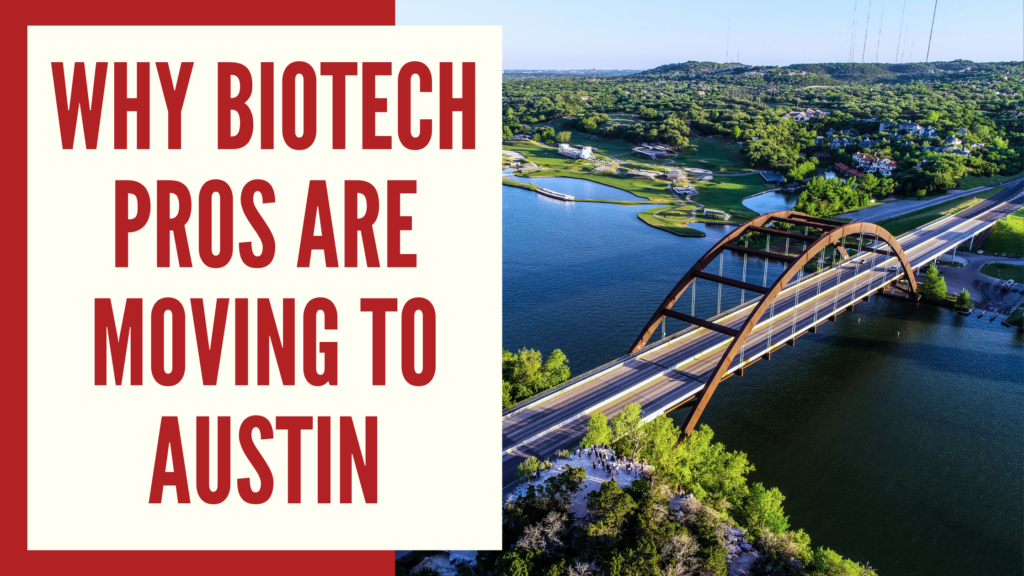
Austin has long drawn professionals relocating to Austin for its tech industry and quality of life. Now, a different kind of professional is paying close attention: researchers, genomics scientists, clinical engineers, and pharmaceutical specialists who see something in Austin that most people haven’t caught up with yet. The city’s life sciences sector is growing faster than almost any comparable metro in the country, and the companies arriving here are not small startups.
According to the 2024 McKinsey Life Sciences Study commissioned by Opportunity Austin, the region is now home to more than 1,100 bio and health companies employing over 21,000 people, with an ecosystem valuation of $42 billion. That number is climbing. New facilities are breaking ground, international headquarters are relocating, and UT Austin’s Dell Medical School continues to attract research funding and innovation at a rate few anticipated when it opened in 2016.
This guide covers what life sciences professionals need to know before making a move: which companies are hiring, what the jobs pay, how Austin compares to traditional biotech hubs on cost and career opportunity, and which neighborhoods tend to work best for professionals in this field. If you are already researching working in Austin, this is a practical starting point.
Austin Life Sciences: Quick Snapshot
- Sector size: 1,100+ bio and health companies, 21,000+ employees, $42B ecosystem value
- 3billion (genomics): 200 jobs, $95K+ average salary, $8.1M investment, first North American HQ
- BillionToOne (diagnostics): 1,000+ jobs, 220,000-sq-ft facility completing in 2026 in EastVillage ATX
- IntraBio: UK pharma company relocated its full corporate headquarters to Austin
- UT Austin research: ~$1B in annual research funding flowing through academic and corporate institutions
- VC ranking: #6 nationally in VC funding per capita for life sciences companies
Table of Contents
Austin’s Life Sciences Growth Is Being Driven by Major Company Arrivals
The most convincing sign that a city’s industry is maturing isn’t a report or a ranking. It’s companies choosing to put their headquarters and facilities there over more established alternatives. Austin is reaching that point in life sciences, and the evidence is concrete.
3billion: A South Korean Genomics Leader Chooses Austin First
3billion, a South Korean company specializing in AI-powered genetic diagnostics for rare diseases, selected Austin as the location for its first North American headquarters. The investment totals $8.1 million, and the Austin City Council approved an economic development agreement in connection with the expansion. The company plans to create 200 full-time positions over the next decade, with an average salary exceeding $95,000 annually.
These are not entry-level positions. The roles span genetic counseling, AI algorithm development, laboratory operations, clinical research coordination, and regulatory affairs. For a genomics professional evaluating career options, the combination of a high-salary employer entering a lower cost-of-living market is worth understanding in detail.
BillionToOne: The Largest Single Biotech Job Addition in Austin’s History
BillionToOne broke ground in September 2024 on a 220,000-square-foot facility in the EastVillage ATX development on East Parmer Lane. The California-based molecular diagnostics company, valued at over $1 billion, expects the facility to be complete and occupied by end of 2026. When fully staffed, it will employ more than 1,000 people across roles ranging from laboratory technicians and clinical scientists to automation engineers and post-doctoral researchers.
The facility will be CLIA-certified and capable of processing up to 6 million high-complexity molecular diagnostics tests annually, with a focus on prenatal and oncology diagnostics. Opportunity Austin CEO Ed Latson described the expansion as directly aligned with a McKinsey-led life sciences strategy for the region, and noted that the move reinforces Austin’s position as a technology-driven innovation hub. For professionals in the diagnostics field, BillionToOne’s hiring waves are expected to begin rolling out in late 2025 and into 2026.
IntraBio and the International Headquarters Trend
IntraBio Inc., a UK-based biopharmaceutical company focused on neurodegenerative diseases including Alzheimer’s and Parkinson’s, relocated its full corporate headquarters from the United Kingdom to Austin in 2024, raising over $40 million as part of its expansion. The fact that a pharmaceutical company chose Austin over traditional US pharma hubs reflects a broader pattern. Austin offers access to clinical trial networks, a growing regulatory affairs talent pool, and significantly lower real estate and operating costs than Boston or San Francisco.
The existing base of established companies adds further stability to the ecosystem. ICU Medical, XBiotech, and Natera all have meaningful Austin operations, and the region’s more than 1,000 life sciences startups provide additional hiring depth for professionals at all career stages.
What Life Sciences Jobs in Austin Actually Pay
Salary data for Austin’s life sciences sector reflects a market that is competitive with larger biotech hubs while offering a meaningfully lower cost of living. Here is a general picture of compensation across common roles in the field.
Salary Ranges by Role
- Research Scientists (PhD). $85,000 to $140,000 annually, depending on specialization and employer. Roles in genomics, molecular biology, and computational biology are at the higher end.
- Biomedical Engineers. $90,000 to $160,000 annually. Strong demand from both established companies and funded startups across the medical device and diagnostics sectors.
- Laboratory Directors and Managers. $100,000 to $200,000 annually. Senior leadership roles in a growing sector where experienced talent is in shorter supply.
- Regulatory Affairs Specialists. $80,000 to $120,000 annually. FDA compliance expertise is in high demand as more companies scale toward commercial-stage operations.
- Clinical Research Coordinators. $65,000 to $90,000 annually. Many positions are accessible without advanced degrees and offer strong upward mobility.
- Automation Engineers. $95,000 to $150,000 annually. Particularly relevant for diagnostics companies like BillionToOne that rely on high-throughput laboratory automation.
How Austin Compares to Boston, San Francisco, and San Diego
In the major biotech corridors, a $120,000 salary in Cambridge, Massachusetts or South San Francisco buys a different standard of living than the same figure in Austin. Texas has no state income tax, which adds roughly 5 to 13 percent in effective take-home pay compared to California or Massachusetts. Housing costs in Austin, while higher than they were five years ago, remain well below those in traditional life sciences hubs. A professional earning $110,000 in Austin has considerably more purchasing power than a counterpart earning $130,000 in the Bay Area.
Austin’s 2024 Bio and Health Report also found that 40 companies in the sector are valued above $100 million, with average startup valuations competitive with San Francisco, Boston, and New York. For professionals considering equity in early-stage companies, the opportunity profile is no longer materially different from what those cities offer.
The No State Income Tax Advantage
For a research scientist earning $130,000 annually, moving from California to Texas means retaining roughly $12,000 to $16,000 per year that would otherwise go to state income tax. Over five years, that difference compounds significantly, particularly when combined with lower housing costs and a real estate market where buying a home in Austin remains more accessible than in peer markets.
Free Resource
The Free Austin Relocation Guide
Everything you need to plan your move to Austin, including neighborhoods, schools, cost of living, and what to expect when you arrive. Download it free and keep it as your reference throughout the process.
Why Companies Keep Choosing Austin for Life Sciences Expansion
The concentration of company arrivals in Austin’s life sciences sector is not coincidental. Multiple structural factors make the city a logical location for companies evaluating where to place major facilities or headquarters.
UT Austin and Dell Medical School as Research Infrastructure
UT Austin’s Dell Medical School, which opened in 2016 with a deliberate focus on innovation and entrepreneurship, has become a genuine catalyst for biomedical development in the region. The Texas Health Catalyst program has generated $61 in follow-on funding for every dollar invested in UT innovators, and the region sees approximately $1 billion in annual research funding flowing through academic and corporate institutions combined. Companies like 3billion can access faculty partnerships, clinical networks, and a pipeline of graduate talent that would be difficult to replicate in a city without a research university of UT’s scale.
Austin’s life sciences employment grew nearly 74 percent over a three-year period according to research by Newmark, with further annual growth of approximately 6.5 percent projected. The Texas Governor’s office also identified life sciences and biotechnology as a priority sector in a 2025 five-year economic blueprint, meaning state-level support for workforce development and infrastructure is likely to increase rather than stabilize.
Business Climate and Economic Incentives
Texas’s business environment is structured to reduce friction for companies in capital-intensive industries. No corporate income tax, new incentives for medical manufacturing equipment, and streamlined city permitting all factor into site-selection decisions. BillionToOne’s team specifically cited the six-month turnaround on Austin’s site development permit as notable. For a company building a CLIA-certified facility with specialized infrastructure requirements, that kind of responsiveness matters in ways that don’t always show up in headline rankings.
Talent Concentration and Cross-Industry Skills
Austin’s existing technology workforce creates a pool of professionals with skills that transfer directly into modern life sciences roles. Data scientists, software engineers, and automation specialists who have worked in Austin’s semiconductor and software industries bring capabilities that diagnostic companies, genomics firms, and medical device manufacturers all need. BillionToOne’s CEO cited Austin’s concentration of STEM graduates from nearby universities as a key factor in the company’s decision. The region’s five-year VC investment in healthcare devices has totaled more than $440 million, ranking sixth nationally in VC funding per capita for the sector.
Best Austin Neighborhoods for Life Sciences Professionals
Where you live in Austin will affect your commute and your daily quality of life differently depending on which employer or research institution you are working for. The city’s life sciences activity is concentrated in a few geographic clusters, which shapes the neighborhood decision for most professionals in the field.
North Austin: The Core Lab Corridor
North Austin is where the majority of laboratory and research facility development is concentrated, driven by available commercial space, access to UT Austin, and proximity to Austin-Bergstrom International Airport. 3billion’s new facility is located in this corridor. Professionals working in North Austin typically find that suburbs like Cedar Park offer an appealing combination of newer construction, strong schools, and manageable commute times. The Domain area provides walkable urban amenities for professionals who prefer a more urban setting without a downtown commute.
East Austin and EastVillage: The Emerging Biotech Corridor
East Austin is seeing significant life sciences development anchored by BillionToOne’s facility at EastVillage ATX on East Parmer Lane. The EastVillage development itself will ultimately encompass 425 acres with residential, retail, green space, and a 1.5 million-square-foot life science campus. Professionals working in this corridor will find East Austin neighborhoods offer a more affordable entry into homeownership than West or Central Austin, with a growing restaurant and retail presence that has attracted younger professionals for several years. As BillionToOne’s hiring ramps through 2026, demand for housing near the Parmer Lane corridor is likely to increase.
Central Austin: Close to Dell Medical School
Professionals affiliated with UT Austin’s Dell Medical School or the university’s research centers often prioritize proximity to campus. Neighborhoods like Tarrytown and Crestview offer reasonable access to the university while providing the established tree-lined character and good school options that appeal to professionals with families. The tradeoff is that Central Austin housing commands a premium.
For those willing to look at Austin real estate across multiple areas before deciding, working with a team familiar with both the job market geography and the neighborhood inventory is worth the time. Spyglass Realty has a strong track record working with relocating professionals in Austin and can provide current market context alongside neighborhood guidance.
For professionals considering suburbs with more space and newer construction, Round Rock offers convenient access to both the North Austin lab corridor and central employment centers. It consistently attracts families relocating for professional roles who want strong schools and a lower price per square foot.
Frequently Asked Questions: Relocating to Austin for Life Sciences Work
Is Austin a Good Place to Build a Life Sciences Career?
Austin has moved from an emerging market to a serious competitor with established biotech hubs. The region now holds more than 1,100 bio and health companies with a combined ecosystem value of $42 billion, has added over 21,000 life sciences employees, and ranks sixth nationally in VC funding per capita for the sector. Companies arriving from South Korea, the UK, and California are choosing Austin as their primary North American or US base, not a secondary location. For professionals earlier in their careers, getting established in Austin now means building a network in a sector with room to grow, rather than competing in an already-saturated market.
How Does Austin’s Cost of Living Compare to Other Biotech Hubs?
Austin is more expensive than it was five years ago, but it remains considerably more affordable than Boston, San Francisco, San Diego, or the New York metro on every major cost-of-living measure. The absence of state income tax means a direct take-home pay advantage for anyone moving from California or Massachusetts. Housing costs, while higher than many mid-size cities, are still in a range where a two-income household earning life sciences salaries can realistically purchase a home. The same is generally not true in Cambridge or the Bay Area on comparable incomes.
What Should I Know Before Relocating to Austin for a Biotech Job?
Austin’s life sciences employment is geographically spread across the city, so neighborhood selection matters more here than in a city with a single concentrated research district. North Austin and the EastVillage corridor on Parmer Lane are where the most significant current and near-term hiring is concentrated. Understanding where your employer is located before you start your home search will save time and reduce commute friction later. It also helps to connect with local professional organizations like BioAustinCTX early, as their networks tend to be active and the Austin life sciences community is still small enough that relationships form quickly.
Where Do Life Sciences Professionals Tend to Buy Homes in Austin?
Professionals working in North Austin’s lab corridor tend to look in Cedar Park, the Domain area, and North Austin neighborhoods that offer reasonable commutes without requiring a drive across the entire city. Those working in or near EastVillage ATX on Parmer Lane often look at East Austin, Manor, and Pflugerville for more affordable options, or Central Austin for proximity to downtown amenities. Professionals affiliated with UT Austin tend to prioritize Central Austin and the neighborhoods near campus. In all cases, working with a real estate team familiar with Austin’s moving to Austin landscape will make the process more efficient and reduce the chance of committing to a neighborhood that doesn’t serve your daily routine.
What This Means for Life Sciences Professionals Considering a Move
Austin’s life sciences growth has moved past the stage where it can be dismissed as regional hype. The combination of a McKinsey-validated industry strategy, concrete facility investments from international companies, a UT research infrastructure producing $61 in follow-on funding per dollar invested, and state policy that prioritizes biotech as an economic sector creates a durable foundation rather than a cyclical uptick.
For professionals who are already employed in life sciences and considering their next move, the timing question is worth thinking through carefully. Austin’s life sciences community is large enough to offer real career options but still at a stage where people who arrive and build networks now will have advantages that later arrivals will not. That dynamic is unlikely to persist indefinitely as the sector continues to scale.
Whether you are evaluating a specific offer or beginning to assess Austin as a medium-term option, the combination of salary levels, cost advantages, research infrastructure, and quality of life makes a serious case worth your time to explore fully.
Ready to Make Your Move?
Talk to a Move to Austin Relocation Specialist
Whether you have a job lined up or are still weighing your options, our relocation specialists can help you build a focused plan around your timeline, target neighborhoods, and budget. We work with professionals relocating to Austin across all industries and know the life sciences corridor well.
Disclaimer: This article is for general educational purposes only and is not legal, tax, or financial advice. Every situation is different. Before making decisions about buying or selling a home, consult with your own real estate professional, lender, tax advisor, and other qualified professionals.